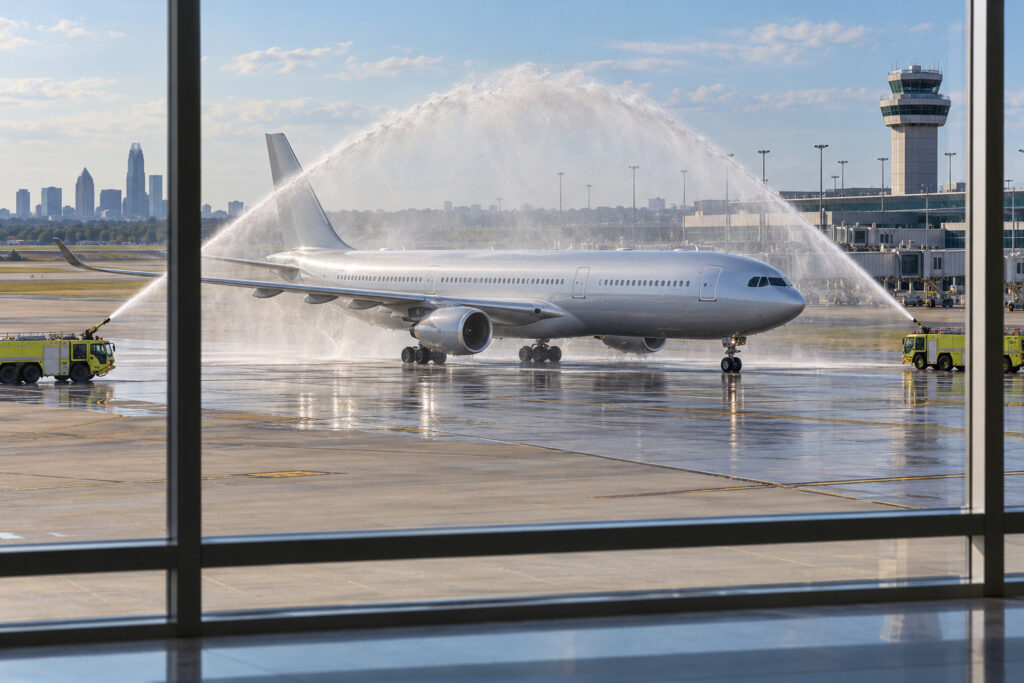
Carol Fair has retired from American Airlines at 83 after a flying career lasting more than 63 years. Her final return to Charlotte on October 26, 2026, brought a celebration of a working life that began with Piedmont Airlines in 1963 and continued through enormous changes in commercial aviation.
Fair left as the airline’s most senior flight attendant. The send-off included colleagues, friends and family, with the airport setting providing an appropriate backdrop for someone whose career had become part of Charlotte’s aviation history.
A final journey with an earlier connection
Her last London-to-Charlotte journey echoed an important earlier assignment. Fair had worked Piedmont’s first Charlotte-to-London flight in 1987, when the airport’s long-haul ambitions were still developing. Returning along that route gave her retirement a connection with a milestone she had experienced from inside the cabin.
An account published ahead of her retirement described that choice and her position at the top of the seniority list. It captured a career coming to a close through a familiar route rather than an arbitrary last assignment.
The arrival celebration in Charlotte drew a crowd to recognize her service. The reception turned a normal airport arrival into an occasion for the people who had worked with her and followed her career.
The cabin changed around her
Fair began when flying involved very different aircraft and much smaller groups of passengers. In a 2025 interview about her place in an aviation museum exhibit, she compared the DC-3, carrying roughly two dozen passengers, with an Airbus A330 carrying close to 300.
The scale changed the job as well as the airplane. A cabin once served by a single flight attendant became a working environment for a larger crew. Coordinating service across a wide-body aircraft demanded a different kind of teamwork from looking after a much smaller passenger group.
She also recalled the restrictions women faced earlier in the profession. Rules about marriage and compulsory retirement at a young age limited the careers available to flight attendants. Her own long service eventually stretched far beyond the working life those rules had originally allowed women to imagine.
Piedmont’s place in later airline mergers meant that her employer’s identity also changed. The consistency came from the occupation itself: helping passengers travel, working with cabin crews and returning to an industry that had become her life’s work.
A personal history preserved in Charlotte
Fair’s story has already been recognized beyond the airline. The retirement coverage notes her induction into the North Carolina Transportation Hall of Fame in 2008 and membership in the Tennessee Aviation Hall of Fame.
The Sullenberger Aviation Museum has also included her experience in Aviation City, an exhibition about aviation in Charlotte and the Carolinas. That setting places a flight attendant’s working history alongside aircraft and the airport’s growth, making clear that the development of air travel involved people as well as machines.
The museum perspective is especially useful for a career of this length. New routes, larger aircraft and changing employment rules can otherwise remain separate historical facts. Fair experienced them as successive stages of the same job.
Her retirement celebration acknowledged that continuity. After more than six decades of boarding aircraft and caring for passengers, she leaves a record of service that reaches from the early Piedmont era to a much larger international airline, with Charlotte running through both chapters.